Quick navigation
Choosing the best generator company in Lagos means looking beyond price. The right supplier sizes your load before quoting, puts exactly what you are buying in writing, installs and commissions the unit properly, and remains available after handover. Price matters, but it should not be the only filter. An oversized, mis-specified or badly installed unit can increase fuel, maintenance and downtime costs over its operating life. This Nigerian buyer’s guide shows how to judge any supplier across the full journey: load assessment, recommendation, quotation, supply, installation, commissioning and after-sales support. Use the same checklist with every company on your shortlist, including us.
✅ Want a second opinion on your sizing? Request a Generator Quote or a Load Assessment.
📞 +2349067441287
📧 titaniumpowersolution@gmail.com🔥 INSIGHT: Ask every supplier the same questions in the same order. The company that gets vague on sizing, specs or support is telling you something before you pay a kobo.
Why Choosing the Best Generator Company in Lagos Matters
Two buyers can purchase the same kVA rating and end up in very different places. One gets a unit sized to the real load, installed with proper ventilation and cabling, and serviced on schedule. The other gets a unit picked off a price list, dropped on a slab and left to cope.
For many Lagos businesses, a generator is an important operational backup and may run for extended periods during grid interruptions. That makes correct sizing, fuel use, uptime and maintenance central to the total cost of the power investment.
A good supplier reduces three risks:
- Sizing risk: buying too big (wasted capital and fuel) or too small (overloads and shutdowns)
- Specification risk: receiving a unit that does not match what was quoted
- Lifecycle risk: having no one to call when the generator trips at 7pm on a Friday
👉 START HERE: Not sure what size you need? Use the load calculator for a starting estimate before you speak to any supplier.
Step 1: Load Assessment (Where Good Suppliers Separate Themselves)
A proper load assessment is the foundation of everything else. If a company quotes a kVA figure without asking about your equipment, end that conversation and ask again, or move on.
What a proper assessment covers
| Item | Why it matters |
|---|---|
| Connected loads | Every item the generator will power: lights, sockets, ACs, pumps, freezers, lifts, medical or office equipment |
| Running vs starting loads | Motors and compressors can draw substantially more current during startup than during normal running |
| Motor and AC inrush | Air conditioners, pumps, lifts and other motor loads can create significant starting demand and may influence sizing |
| Power factor | kVA and kW are not the same; mixed loads change how much usable power you get |
| Single-phase vs three-phase | Your building’s distribution and equipment decide which you need |
| Simultaneity | Not everything runs at once; a realistic usage pattern prevents over-sizing |
| Future expansion | Extra floors, units or equipment you plan to add should be counted now |
| Headroom | A sensible margin so the generator is not running flat out |
Why oversizing and undersizing both hurt
Oversizing can be an expensive mistake. A diesel engine running at very light load for extended periods can suffer wet stacking, where unburnt fuel and carbon deposits accumulate in the exhaust system. Caterpillar notes that extended operation below about 30% of rated load is a typical low-load concern, while manufacturer-specific guidance should always take priority. The practical goal is to avoid selecting a set so large that it spends most of its operating time at very low load.
Undersizing causes the opposite problem: voltage dips, tripping when large motors start, overheating, and a shorter life for the engine and alternator.
A worked example (illustrative only)
Say a small clinic lists the following. These numbers are an example, not a recommendation:
- Lighting and sockets: about 6 kVA
- Three split ACs running together: about 9 kVA running, with higher starting demand
- A small borehole pump: about 3 kVA running, with a startup surge
- Medical and office equipment: about 4 kVA
Add the running loads and you get roughly 22 kVA. Next, check the worst realistic motor-start event while the other required loads are operating, use the actual power factor where kW must be converted to kVA, and allow separately for planned future growth. The final requirement may land in a different bracket from a quick guess, which is why a site assessment should confirm the figure before you commit.
📊 FACT: Sizing is an engineering judgement based on your actual equipment list, not a rule you can lift from a brochure. Treat any online estimate as a starting point.
Read more in our generator sizing guidance before you request an assessment.
Step 2: Supply (Verify What You Are Actually Buying)
Once the size is settled, the supplier’s job is to deliver exactly what was agreed. This is where written specifications and delivery documentation matter.
Get these in writing before you pay:
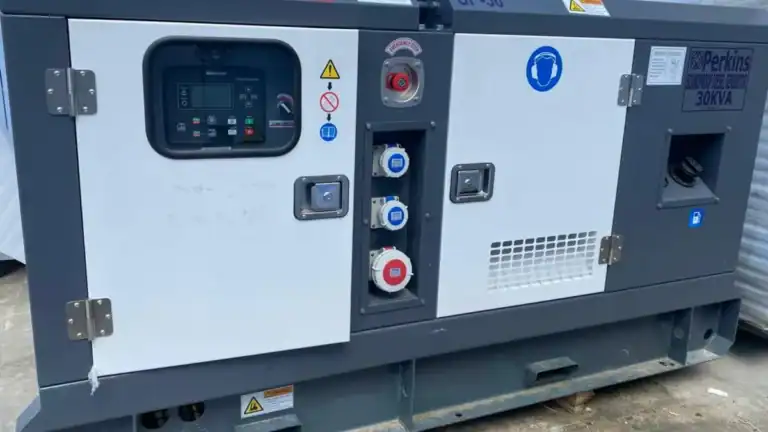
- The exact model and rating, including whether it is stated as prime or standby
- Engine, alternator and control panel details for that specific unit, not “or similar”
- Whether the unit is canopied/soundproof, and which accessories are included
- Warranty terms: duration, what is covered, what voids it and who honours it
- Delivery location and what the quoted price includes (offloading, positioning, accessories)
- Documentation that comes with the unit
Verify condition and specification regardless of sales channel
Whether you are buying through a website, dealer, marketplace or direct supplier, verify the unit’s condition and configuration before payment. Confirm whether it is new, used or reconditioned; check the model and serial details; and compare the delivered engine, alternator, controller and rating with the written quotation. Site conditions and configuration can also affect usable performance.
Practical checks:
- Ask for the paperwork: model, serial details and the specification sheet, then compare them with what is physically delivered
- Inspect on delivery: do it before you sign off
- Get responsibility in writing: who pays if the unit does not match the quote?
- Treat reluctance as a warning: be cautious of any supplier who will not put specs and warranty terms on paper
Generator pricing is not a single number. Quotes vary by capacity, configuration, installation requirements, delivery location and accessories, so compare like with like. A lower figure that leaves out cabling, ATS or commissioning is not actually lower.
Step 3: Installation and Commissioning
Installation is where generator selection becomes a complete power system. In Nigeria, the Nigerian Electricity Management Services Agency (NEMSA) is responsible for enforcement of technical standards, inspection, testing and certification of electrical installations. Electrical work should therefore be carried out by appropriately qualified personnel and in line with applicable Nigerian requirements.
Ask any supplier how they handle each of these:
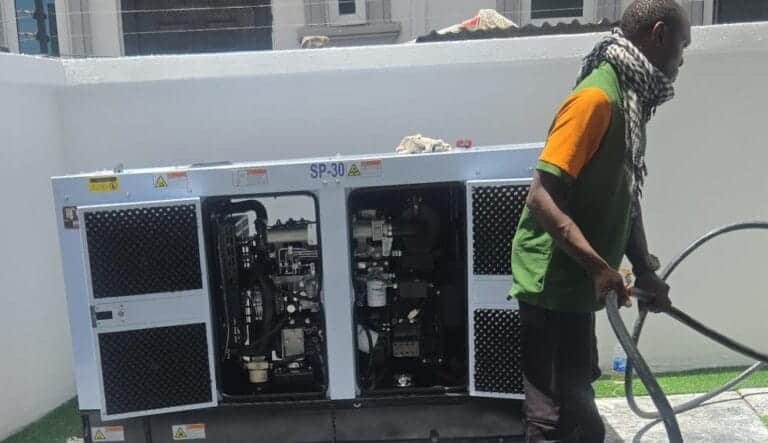
- Site and positioning: a stable base, safe access for service, and clearance around the unit
- Ventilation and airflow: cooling air has to get in and hot air has to get out, or the unit overheats
- Exhaust routing: fumes must be directed safely away from people, windows and air intakes
- Fuel storage and supply: safe tank placement, correct piping and spill considerations
- Cabling: correctly sized cables and protection for the load and the distance
- Earthing: proper earthing is a safety requirement, not an optional extra
- ATS integration where required: an Automatic Transfer Switch moves your load between mains and generator without manual intervention, which suits sites that cannot afford delays
- Commissioning: testing the unit under appropriate operating conditions, with on-load or load-bank testing where the application requires it, to confirm the installation performs as intended
- Handover: basic operating instructions, safety guidance and a record of what was installed and tested
Clarify before payment whether installation is included, who will perform and supervise the electrical work, what testing is included, and who is accountable for the completed installation.
Step 4: After-Sales Support
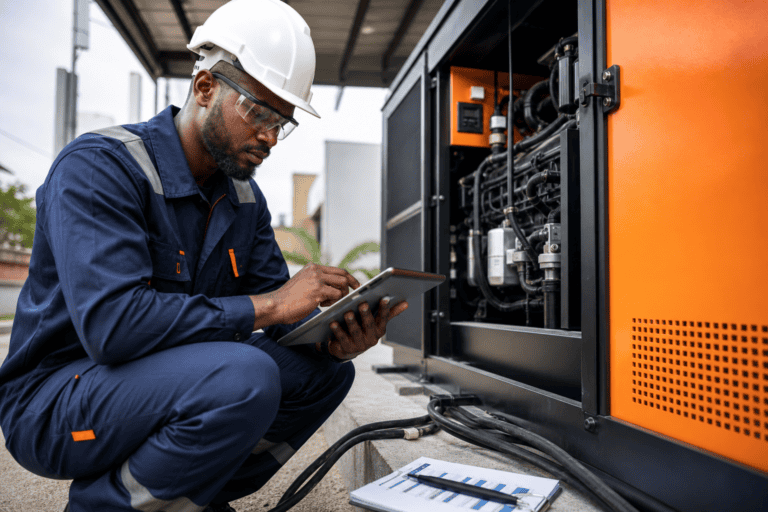
A generator is a running machine. It needs oil changes, filter replacements, coolant checks and inspections, and poor maintenance can contribute to avoidable breakdowns and downtime.
Ask about:
- Preventive maintenance: is there a scheduled servicing plan, and what does each visit include?
- Corrective maintenance and repairs: who responds when the unit fails, and how do you reach them?
- Spare parts: how are parts sourced, specified and matched to your exact model?
- Technical support: can you reach someone knowledgeable by phone or WhatsApp when something looks wrong?
For Lagos businesses where an outage can interrupt operations, support after the sale is part of the buying decision. TPS provides generator maintenance and servicing, and buyers should ask every supplier to define clearly what post-installation support is available.
What About Solar and Hybrid?
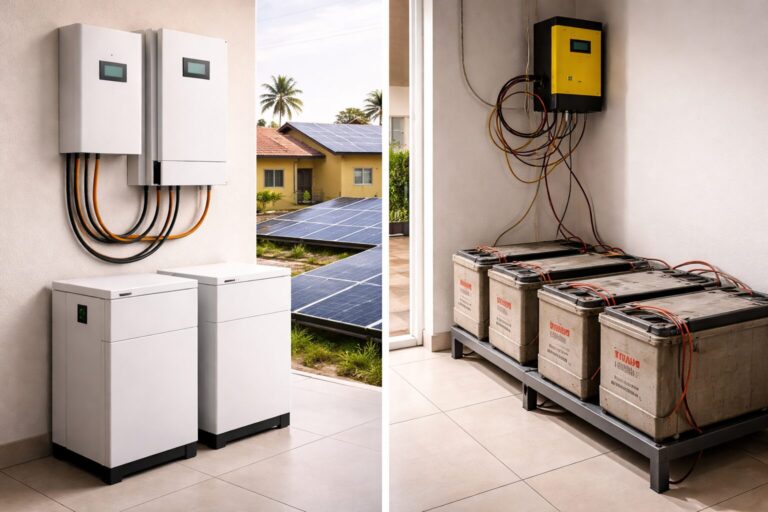
Some sites combine generators with solar, batteries or other power sources to reduce generator runtime. Whether that makes commercial and technical sense depends on the load profile, available space, operating hours, control strategy and project budget. Treat hybrid design as a separate engineering decision rather than assuming it is automatically the best fit.
Questions to Ask Any Lagos Generator Company Before You Pay
Print this list and use it with every supplier:
- How will you determine my load? Do you do a site assessment, or only a phone estimate?
- Can I see the sizing logic behind your recommended kVA?
- What exact model, engine, alternator and controller am I getting, in writing?
- Is the rating prime or standby, and is the unit new?
- What does the warranty cover, for how long, and who honours it?
- What is included in the quote (delivery, offloading, cabling, ATS, accessories, commissioning)?
- Who installs it, and who is accountable for the workmanship?
- How is the unit commissioned and tested before handover?
- What maintenance plan do you offer, and how quickly can I reach support?
- Where do spare parts come from, and can you source them for my model?
- Can you handle ATS integration if my site needs it?
- What happens if the delivered unit does not match the quote?
Red Flags to Watch For
- A kVA recommendation with no questions about your equipment
- No written specification, or an unwillingness to name the exact model
- Warranty terms that are verbal only or vague
- Pressure to pay in full immediately with no documentation
- A price far below the others with no explanation of what is excluded
- No installation or commissioning plan, just delivery
- No clear route for support or servicing after the sale
- Claims of being the “authorised partner” of a brand with nothing to verify
How Titanium Power Solutions Approaches This Journey
We are one option you should evaluate with the same checklist above. Here is how we work, without overclaiming.
Titanium Power Solutions is a Nigerian B2B power-solutions company. We supply soundproof diesel generators from 15kVA to 1000kVA, with nationwide delivery. Quotes depend on delivery location, capacity, configuration, installation requirements and accessories. The exact engine, alternator, controller, warranty terms, availability and delivery scope should be confirmed in the written quotation for the specific unit.
Our approach is to size the load first, then deliver, install and service:
- Load calculator and load assessment: start with the online calculator, then request a load assessment to confirm your size
- Supply: soundproof diesel generators matched to your confirmed requirement
- Installation and commissioning: including ATS integration where required
- Maintenance and repairs: preventive and corrective servicing, plus technical support
- Enquiries: by WhatsApp, phone or through the website
Whichever company you choose, hold them to the same standard: assess first, specify in writing, install properly and support after handover.
✅ Ready to compare? Request a Generator Quote, Calculate My Generator Size, Request a Load Assessment or Chat on WhatsApp.
📞 +2349067441287
📧 titaniumpowersolution@gmail.com
Frequently Asked Questions
How do I know what kVA generator I need for my business in Lagos?
List every piece of equipment you want powered, flag the motors and air conditioners with higher startup demand, and allow for future growth. Use a load calculator for a starting estimate, then have a site assessment confirm it. Copying a neighbour’s setup is a common route to oversizing.
Is the cheapest generator quote the best option?
Not necessarily. A lower quote may exclude installation, cabling, ATS, commissioning or accessories, so compare suppliers on the complete scope, exact equipment specification and after-sales support rather than headline price alone.
What is wet stacking, and why can oversizing contribute to it?
Wet stacking can occur when a diesel generator operates at very low load for extended periods, allowing unburnt fuel and carbon deposits to accumulate in the exhaust system. Caterpillar identifies prolonged operation below about 30% of rated load as a typical concern. Correct sizing and manufacturer-specific operating guidance help reduce that risk.
Do I need an Automatic Transfer Switch (ATS)?
Only where your site needs automatic changeover between mains and generator, such as clinics, supermarkets with cold storage or offices that cannot tolerate manual delays. A supplier should assess this during your load assessment rather than adding it by default.
Why does installation matter so much?
Poor ventilation, wrong cable sizing, weak earthing or badly routed exhaust can cause overheating, shutdowns and safety hazards, even with a good generator. Commissioning under load is what confirms the unit performs as specified.
Can a generator work alongside solar or hybrid systems?
Yes. Some sites combine them to reduce generator runtime. Diesel backup remains appropriate where loads are heavy or critical, or where solar capacity is limited. The right mix depends on your load and site.
How much does a generator cost?
Pricing is quote-based and varies by capacity, configuration, installation requirements, delivery location and accessories. Request a quote with your load details so the figure reflects what you actually need.
Conclusion
The best generator company in Lagos is the one that fits your load, your site and your support needs, not the one with the loudest advertising or the lowest headline price. Check how they assess, what they put in writing, how they install and commission, and what happens after handover. Do that with every supplier on your list.
If you want to see how we measure up, start with the sizing tool on Titanium Power Solutions, browse the generator range, or contact TPS for a load assessment or project-specific quotation.